
Startups Operators & Athletes - Chapter 1: Nutrition
What startups can learn from athlete nutrition?

Back in summer 2022, I registered for a trail running training course. I did it for two main reasons: my personal interest in running and my gut feeling: that startups & their team could apply concepts from sport sciences & training to their day to day in order to perform and grow sustainably. End January, I had the first 4 days in person workshop, which inspired me with a series of articles around nutrition, mental preparation and planning - from athleticism to startup. This first one focuses on how nutrition can help us - startup operators - perform better.
Eating = Energy
If we had to summarize the key function of eating in one word it would be: Energy. The food we eat provide us with a source of energy that is necessary for:
metabolism (digestion, breathing, etc)
training (in sports) which we could correlate to think, reflect & act in the startup world
muscular preparation (mainly interesting for sports) & recuperation. Recuperation is what will interest us more specifically in this article.
In other words, eating is our fuel to make our body and brain work. It generates energy and those who work or have worked in startups will know that energy is key to perform and to feel well.
As a matter of fact, an adult human brain accounts for about 2% of its body’s mass, uses 20% of its metabolic energy.
In the past 7 years in the startup world, I have seen many colleagues skipping food. “I have so much to do”, “I can’t take a break” or whatever reasons they said. While at the moment this might seem heroic, there is probably nothing more stupid to do.
In fact, not eating will keep our energy low, affect our brain & concentration, and therefore impact our performance and harm our work, our relations with our team and most importantly ourselves.
Some good hacks if you know you likely not have time to go grab lunch is to:
Cook a bit extra the day before and take the leftovers with you.
Take a sandwich on your way to work in the morning.
Pre-order with Rappi, UberEat or in some countries you even have full week nutrition plan options like Manzana Verde.
Organize a rotation with your team (4-5 people) and have each day of the week someone else cooking for the group. Yeah, it sounds like a great team building activity too!
Note: I have read about people fasting for a couple of days and apparently after day 3, skipping food will no longer have an impact on their performance, mood and concentration. However, it is recommended to fast under supervision of a nutritionist or expert and only for a short period and short frequencies. You don’t have to fast to perform and feel better.
The 3 functions of Food
Food has 3 main functions:
biological: providing energy for the metabolism as seen before.
social/cultural: eating is an act of social interaction as well as a symbol of our different culture. If I say Mexico, Peru, Brasil, Venezuela - which food comes to your mind?
hedonist: the little pleasure ;)...
Taking this into our world, think about scheduling lunch with colleagues, clients, partners or users of your app/platform.
This will help you cover your biological needs, while getting the opportunity to link your lunch with a social moment where you will build trust and memories with your guest. Plus, you might learn great insights for your company!
Mindful Eating
During the workshop, the nutritionist mentioned the concept of mindful eating.
Per definition it is, “using all of your physical and emotional senses to experience and enjoy the food choices you make” (source. hsph - Harward).
So in practices, it can be:
When you want to eat something, ask yourself why? Are you hungry? or is it for pleasure? or because you have an important call and you need something to get your mind busy before it? ;)
When you eat, take the time, concentrate to taste the food, ask yourself which part of the plate you feel the most enthusiastic to eat etc.
According to nutrition sciences, eating during meals should last at least 20 to 30 minutes so that our brain can recognise the activity. Shorter time might not allow our stomach to inform our brain we are eating. It means eating slower.
Furthermore, if we do something else while eating such as watching our phone - the brain doesn’t recognise the activity and will not feel satiety. So phone in the bag, during the meals.
Considering all the rise of complains about “zoom overdose”, “too much screen time” - an easy hack on which you have control is to let your phone in your backpack while you eat (yes, I know…sometimes you have that day with 5 zoom meetings one after the other, so you will take opportunity to eat during you team zoom call…that’s okay as long as it is not an habit.)
Some interesting tips we got and that were helpful for me in order to improve my “eating behavior”:
to sit down to eat. (yes that means, avoid eating in the cab between two meetings)
to cut the food in smaller pieces than I was used to.
chew at least 10 times each bite. (Might be particularly useful when you go to cocktail & meetup, so you stop spending time going back to the food table, serve yourself & overeat instead of properly networking)
Anti-Stress Food
In the last few years, more and more scientists have started to study the positive impacts food can have on mental health. Different studies have shown different micronutriments (vitamin, minerals, amino acids, etc). help reduce stress, anxiety and depression.
When working in startups we are constantly fighting against time. We have ambitious goals and little ressources. All in all means a lot of pressure and stress to manage, which is why it is even more important to avoid shortcoming in vitamins and nutrients that might increase our stress and anxiety
Some examples of things to look at in your nutrition:
Low level of Vitamin D causes depression, low mood & risks of stroke. You can find Vitamin D in oily fishes, eggs and above all 5-25 minutes walk in the Sun.
Vitamin B6 helps reduce anxiety. You can find B6 Vitamin in great quantities in the offals but also in cereals, green vegetables, bananas, and dairy products.
Omega 3 supports memory, concentration and boost energy (see more info later in the article)
Zoom in: Omega 3
Something that caught my attention during our nutrition course was the importance of Omega 3 and the fact that most people lack it.
This type of fat is essential for the microbiota but also and mostly for concentration and memory.
To get you needed daily dose of Omega 3 here are some ideas:
2 soup spoon of colza oil, has to be cold.
5 walnuts (other type of nuts doesn’t work)
1 spoon of Chia seeds moistened with water
or 2-3x a week fat fishes such as sardine, herring, anchovy, etc.
Variety of Nutriments
As we discussed earlier, eating`s main role is generating energy. Energy is created by consumption of:
Glucides
Lipids
Proteins (don’t produce energy but are essential for muscle structuration & regeneration)
Let’s look at some of the food categories that are especially important for us.
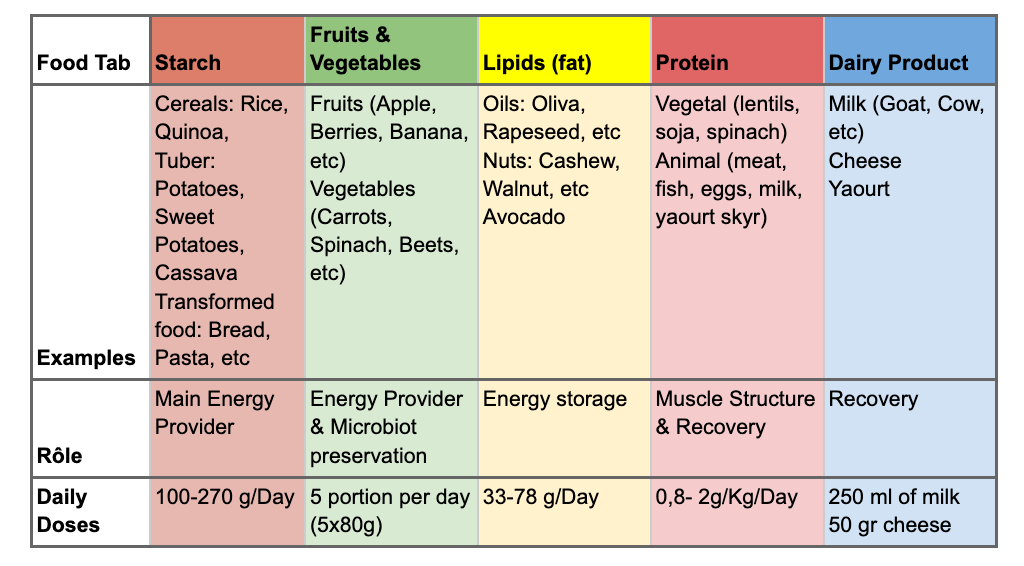
Note this:
40-60% of our food should come of starch, vegetables & fruits
20-35% of our food should come from lipids (fat)
10-15% of our food should come from protein.
Dairy products are “ a nice to have” as you can find calcium and protein in other types of nutrients. However for athletes, they are quite great to help with recovery and might be good to include them (ca. 5%)
Proteins - What about Vegetarians?
Food sources of protein also bring iron to our body. As a vegetarian, the risk of having deficiency in iron and B2 vitamins is higher. This is due to the fact that non animal proteins don’t assimilate iron well.
Therefore it is highly recommended to consume vitamin C products (lemon, orange, parsley, pepper, etc) - AT THE SAME TIME as you eat your vegetal source of protein.
Women are also more propice to iron & vitamin b12 deficiency, as we menstruate.
Not having enough iron can lead to different syndromes such as lack of energy, irritability, intense feeling of being tired. B12 shortages cause depression and poor memory.
As for vitamin B12, you find it mostly meat and fish. It is also present in eggs and dairy products however in smaller quantities. It is likely you should take dietary supplements if you are vegetarian or vegan to reach the required quantity.
Hydration: Water, what else?
Last but not least, let’s talk about hydration.
Drinking enough is highly important for our body and brain to work at their best.
Dehydration can causes: fatigue, headache, low blood pressure, high heart rate.
The aim is to replace the water consumed by our body during the day with our alimentation and metabolism.
Usually it is recommended to consume 2.6 liter/ per day:
1.3l coming from drinking, preferably water.
1l coming from our alimentation (fruits, vegetables mainly)
0.3l regenerated by our own metabolism
Have your cool reusable water bottle near your workplace.🌎 It’s good for you and for the environment. Just avoid turning it over to your computer :)
Notes:
Coffee & Tea don’t hydrate and so can’t count among the 1.3l. So sad, otherwise startup operators will be mastering hydration. An idea would be to always grab a glass or some swipe of water when you go for your coffee.
Avoid drinking too much during meals as it might make the digestion phase harder. Yeah those moments when you come back to work after lunch and just want to go for a nap…
Alcool? The worse for hydration…Sorry again
If you practice sport during the day a good rule of thumb is to add 1 milliliter of water per calorie lost.
8 Food Hacks for Startup Operators
To sum up here are 8 of my favourites food hacks mentioned over the article:
Hack n°1: EATING = ENERGY, SO EAT & EAT WELL
Hack n°2: Mix biological with social needs, go for lunch with colleagues, clients, users, etc.
Hack n°3: Phone in the bag during meals!
Hack n°4: When your protein comes from vegetal source, eat it with Vitamin C to better assimilate iron.
Hack n°5: Eat 5 walnuts (rich in Omega 3) per day to boost your memory & concentration.
Hack N°6: Drink enough water during the day regularly in small sips to avoid fatigue & remain concentrated.
Hack N°7: Diversify & Experiment.
Hack n°8: After fundraising pitch, hard call with client: chocolate, cookies, or even beer.
Final Nutrition Tips & Disclaimer
This article aims to share some basic insights on healthy nutrition with a special focus on people that are often under mind and/or body pressure like startup founders, operators and athletes. IT DOES NOT REPLACE A CONSULTATION WITH AN EXPERT IN NUTRITION.
Some last remarks shared by the nutritionist who gave us the workshop
Listen to yourself when it comes to when you want to eat and what you want to eat.
Note: the only moments you should not listen to yourself as an athlete are during long training and high intensity training. Correlating this to startup operators: it might mean during long period of work or very intense work (for example: the D day of a big conference organized by your company or when fundraising) - your body might be in a flow that it forgets about food and so you need to remind you to eat - mechanically.
Experiment - again we are all different, so try to test food, quantity, times, etc.
#InExperimentWeTrust ;), Be curious and study what works the best for you. Exactly like A/B testing!
Promote Diversity.
Talking with a good friend of mine also in the startup world (Lorena to not name her), we realized this one was quite challenging as sometimes we might love to go for the same meal every day to avoid thinking about what to eat, and gain time. Remember time is precious in startups.
Some additional ideas:
Cook some extra at night and replace the ingredient you were used to by another one. Pasta for Quinoa, Meat for lentils, etc.
Or, thinking local: in Latin America most countries have incredible sorts of fruits; challenge your team to taste all the fruits coming from your country within a year, etc.
Order from those healthy salad restaurants where you can easily switch ingredients from one day to the others.
Avoid ultra processed, fried or high in sugar food (which is most of the food you buy in supermarkets).
You will feel sleepy in the afternoon and it will be harder to work. Furthermore, it increases inflammation in the brain & body, and so the risk of weight gain, heart disease and depression.
Prioritize local and from season food. Better for the nutrients they bring and MUCH BETTER for our planet! 🌎
The Little pleasure: No - eating some swiss chocolate, a spoon of dulce de leche, some alfajores, or un poco de natilla won’t kill you or make you perform badly.
In fact if you really dream of it, better you eat it as your brain won’t go over it by eating an apple and will ask for this sugar till he gets it. And f**k sometimes after a hard day or meeting you need it. At the end it’s again a question of doses: little pleasure means little doses.
Hope you learned some cool stuff reading this article. Have fun experimenting and adding variety to your food and let us know in the comments what are your personal nutrition hacks to be in shape.